Essay
Free vs Premium calorie trackers
A free tier is a statement about what the company thinks the product is for. Free should mean usable, Premium should mean deeper, and the moment free means "annoying enough to upgrade" you are looking at a demo with a countdown on it.
Updated 2026-08-16By Chris RichardsAll posts
A free tier is a promise, not a discount
There are two honest ways to run a free tier. One is a smaller version of the product, permanently usable, where paying buys depth. The other is a clearly labelled trial. Both are fine.
The third pattern is the one to watch for: a free tier engineered to be just usable enough to build a habit and just irritating enough to convert it. It looks generous on the store listing and is not, because what is being extracted is your daily attention rather than your money.
Assume you will use whichever tracker you pick for a year. That reframes the question from "what does this cost" to "what is this like on day 200".
The three ways free tiers get broken
Three mechanisms, in rough order of how much they will annoy you.
- Feature removal, usually of something previously free. MyFitnessPal’s own plan comparison lists barcode and meal scanning under its paid tiers — and barcode scanning is not a luxury, it is the fastest accurate way to log a packaged food.
- History truncation. Cronometer’s pricing page describes basic charting on the free tier within a 7-day window, with unlimited historical data as a Gold feature. This one bites late: the data is collected the whole time, and the paywall arrives exactly when the history becomes interesting.
- Advertising. Cronometer lists ad-free nutrition tracking as a Gold benefit, which tells you what the free tier looks like. In an app you open four times a day, this is the costliest of the three.
What the market actually charges
Two vendors publish clear prices on their own websites, so those are the ones worth quoting. Both were checked on 12 August 2026 against the vendor’s own page. App Store, regional and promotional pricing all differ from web pricing, so treat these as reference points rather than as what you will be charged.
MyFitnessPal, on its Australian pricing page, lists Premium at A$129.99 a year, and Premium+ at A$159.99 a year or A$39.99 a month. Cronometer lists Gold at US$59.99 a year — presented as US$4.99 a month — or US$10.99 billed monthly.
We are not quoting more of the category because several trackers do not publish a price you can verify without opening a store page in your own region, and the figures on comparison sites contradict each other. A number we cannot check is worse than no number.
What should be free
Our position: if the app cannot support the core daily loop without payment, it is not a free tier. The loop is log, see, and check the trend.
- Recording food today, by every input method the app supports — including barcode scanning. Restricting an input method restricts the behaviour itself.
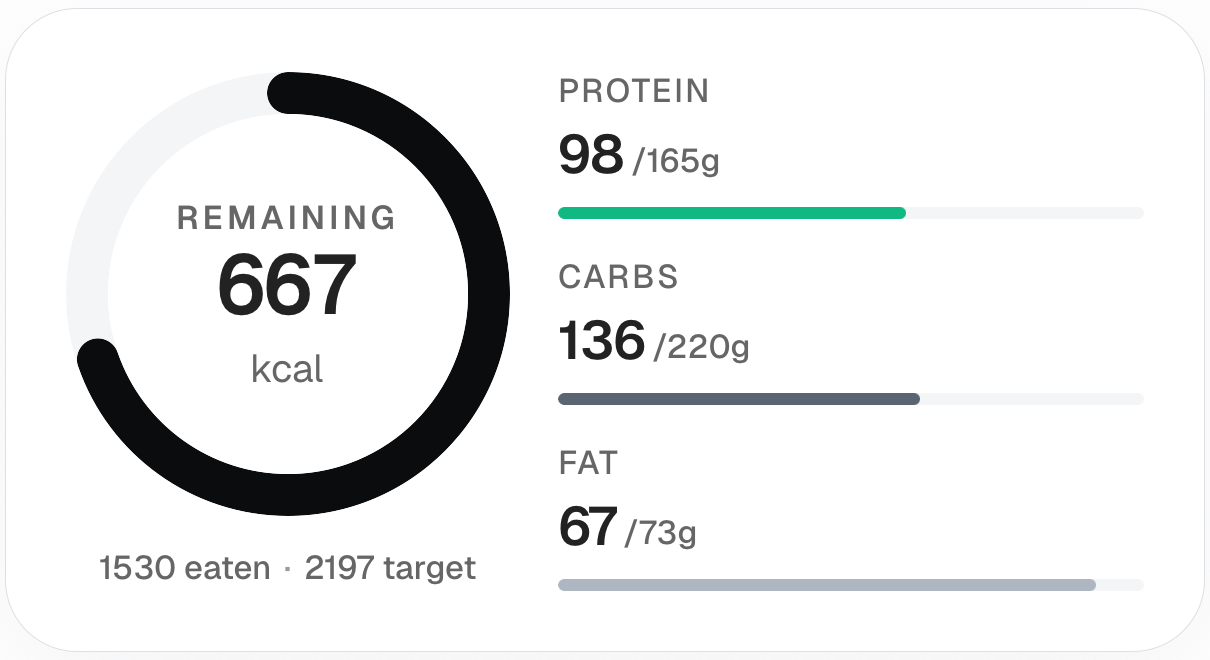
- Seeing today: calories and the three macros, with what is left of each.
- Logging weight and seeing a recent trend.
- Enough history for a weekly comparison, since the week is the smallest unit that means anything.
- No advertising, and data export and deletion that work without a retention flow in the way.
What is fair to charge for
Building software costs money, and a tracker with no revenue model becomes either an ad platform or an abandoned app. The fair version charges for depth on top of a working product rather than for permission to use it.
Long-range history and year-over-year views. Advanced charts and analysis. Coaching, adaptive targets and meal planning — things with ongoing cost behind them. Themes and cosmetics, which are the most honest paid features in software because nobody is worse off without them.
The line we would defend: nothing that gates the daily loop should ever move to the paid side. A feature that was free and becomes paid is a different transaction than a feature that was always paid, and users are right to be angry about the first one.
For our own part: core logging in Corvex is free — AI lookup, barcode scanning, recents and manual entry, the daily calorie and macro view, and weight tracking with its trend line. Premium extends history, adds advanced charts and unlocks the full sticker library. No ads on any tier, which is the decision we would keep if we had to drop all the others.
The counter-argument for paying early
The honest case against everything above is that a good free tier can keep you on a tool that a paid one would have out-performed. Adaptive coaching and detailed analysis are real features, and being principled about free tiers is not the same as being right about what you personally need.
The rule is sequencing, not abstinence. Prove the habit on the free tier for a month. If you are still logging at day 30 and you have hit a specific limitation you can name, pay for it. If you cannot name the limitation, the subscription is buying motivation, and subscriptions have never once supplied that.
Before you subscribe to anything
A short checklist, mostly assembled from mistakes people make repeatedly.
- Check the price in your own App Store. Web pricing and store pricing differ, and both differ by region.
- Annual plans here are usually a large discount, and also a large sum paid up front for an app you may abandon in March.
- Cancel from the App Store subscriptions screen, not from inside the app. Deleting an app has never cancelled its subscription, and this is the most common billing mistake in the category.
- Set a calendar reminder two days before any free trial ends.
FAQ
Is a free calorie tracker good enough?
For the core job — log food, see calories and macros, track weight — yes, provided the free tier includes every input method and enough history for a weekly comparison. What you give up is long-range history, advanced analysis and coaching.
Why do calorie trackers put barcode scanning behind a paywall?
Because it is a conversion lever: high-frequency, obviously valuable, and hard to work around. MyFitnessPal’s own plan comparison lists barcode and meal scanning under its paid tiers. Corvex keeps barcode scanning free on every tier.
Are these prices what I will pay?
Not necessarily. The figures here were checked on 12 August 2026 against each vendor’s own website, in the currency stated. Store, regional and promotional pricing vary, so confirm in your own App Store before subscribing.
Sources
- [1] MyFitnessPal Premium and Premium+ plan comparison — Premium A$129.99/year; Premium+ A$159.99/year or A$39.99/month; barcode and meal scanning listed under paid tiers — MyFitnessPal (checked 12 August 2026)
- [2] Cronometer Gold pricing — US$59.99/year (US$4.99/month) or US$10.99/month; ad-free tracking and unlimited historical data listed as Gold features, free tier charting within a 7-day window — Cronometer (checked 12 August 2026)
General nutrition information, not medical advice. Calorie and macro targets are estimates — talk to a doctor or a registered dietitian before changing your diet, especially if you are pregnant, managing a health condition, or have a history of disordered eating.
Get the app
Open Corvex on your iPhone
Track calories, weight, and macros in a daily log you will actually keep — then share progress stickers in one tap.