Essay
Why most calorie trackers feel like work
Recording food is not intrinsically hard. Weighing rice is not hard. What is hard is a daily ritual built like an accounting package, funded by advertising and scored like an exam. Most of that friction was designed in, which means it can be designed out.
Updated 2026-08-12By Chris RichardsAll posts
The category optimised for the wrong number
For most of the past fifteen years, the way to win in this category was to have the biggest database. MyFitnessPal advertises 20.5 million foods on its own homepage. Cronometer advertises around a million, but insists they are verified and lab-analysed. Both are real achievements. Neither is the number that decides whether you are still logging in November.
The number that decides that is how many seconds it takes to record a Tuesday lunch you have already eaten forty times. Nobody puts that on a homepage. It is unglamorous and it does not grow by scraping more data.
So food logging became search-first. A search box assumes every meal is a new problem. For most people, most meals are not new problems — they are the same eight breakfasts on rotation. Designing the primary interface around the rare case, and leaving the common case as a scroll through history, is the original sin of the category.
Ads break a ritual differently than they break a feed
An advertisement in a social feed is a tax on entertainment you were not going to remember. An advertisement in a food log is a tax on a behaviour you are actively trying to make automatic — and automaticity is exactly what advertising interrupts.
The mechanism is boring rather than sinister. Each interstitial attaches a small negative expectation to opening the app. You start batching. Batching means logging from memory at 9pm, memory is bad, the numbers get vague, the vague numbers stop being worth the effort, and the whole thing quietly ends. Nobody experiences that chain as "the ads got me". It is experienced as "I fell off".
The guilt loop is a UI pattern, not a personality flaw
Look at what happens on a day you go over. The remaining-calorie figure turns red. It renders as a negative number. A streak counter resets to zero.
Now look at the arithmetic. Eating 2,600 against a 2,200 target is a four-hundred-calorie miss on one day of a seven-day average — roughly a 2.6% difference across the week. It is close to meaningless. The interface renders it as failure because failure is legible and a 2.6% deviation is not.
Do that repeatedly and the app stops being an instrument and becomes a judge. People do not keep appointments with judges. The single most common way tracking ends is not a decision to stop; it is one bad day that nobody wanted to record, followed by a second, and then an app icon that has become slightly unpleasant to look at.
The strongest argument against everything above
The honest counter-argument is that some of the friction is the point. Deliberateness is part of why self-monitoring works at all. Burke and colleagues reviewed 22 studies of self-monitoring in weight loss and found a consistent association between self-monitoring and weight loss — while explicitly rating the evidence weak, because of methodological limits and samples that were overwhelmingly white women. Frictionless logging that degrades into guessing may throw away the mechanism along with the annoyance.
There is a second counter-argument worth taking seriously: pretty is not the same as good. An app can be calm, beautifully typeset and still wrong about your intake, and a beautiful wrong number is more persuasive than an ugly one. Aesthetic design has its own failure mode, which is looking authoritative while estimating.
So the claim is not "make it effortless". Effortless food logging is a marketing promise that nobody has kept. The claim is narrower: spend the effort on the food, not on the software. Weighing your oats is effort that buys accuracy. Waiting out a video ad to reach the search box is effort that buys nothing.
What the effort should be spent on instead
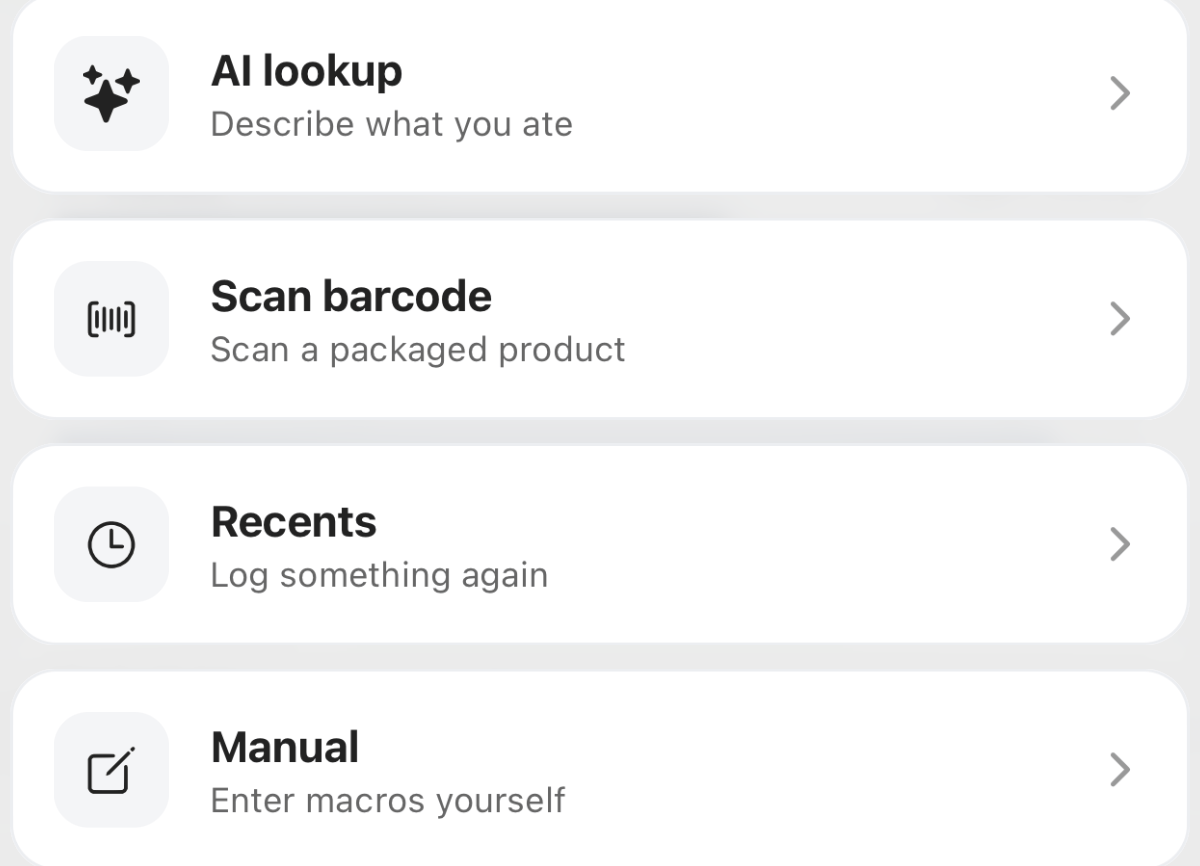
A tracker that respects the shape of real eating puts the repeat case first.
- Recents and saved meals on the first screen of the log sheet, not three taps in — because the eighth time you eat something should cost less than the first.
- A way to describe a meal in plain words when there is no database entry to find. Corvex has an AI lookup you talk to in a sentence; it is an estimate, and it is honest about being one.
- Barcode scanning that stays free — the moment it moves behind a paywall is the moment a free tier becomes a demo.
- Weight shown as a trend line rather than this morning’s number, so a single reading cannot ruin a Tuesday.
- The week visible at once, because the week is the unit that means anything and the day is mostly noise.
A one-week test for any tracker
Before you commit to an app for a year, run it for seven days and answer these. They are more predictive than any feature list.
- How long does a repeat meal take on day six versus day one? If it has not got faster, the app is not learning from you.
- What happens on screen when you go over? If the answer involves red text and a reset counter, you have found the thing that will eventually end this.
- Did you open it voluntarily on a day you had no intention of logging? That is the honest measure of whether the daily view is worth looking at.
- Can you leave — export, cancel, delete — without a fight?
FAQ
Is calorie tracking supposed to be this hard?
Recording what you ate should take under two minutes once your regular meals are in the app. If it consistently takes longer than that, the cost is coming from the software rather than from the tracking itself.
Does a smaller food database make a tracker less accurate?
It makes it less complete, which is a different problem. Larger databases are mostly larger in user-submitted entries, so they also carry more duplicates and wrong entries. What matters for a trend is that you log the same food the same way each time.
I keep quitting after two weeks. Is that normal?
It is the most common pattern in the category. It usually traces to a specific friction point rather than motivation — a slow log flow, ads, or an interface that renders an ordinary day as a failure. Identify which one, and the restart tends to go better.
Sources
- [1] Burke LE, Wang J, Sevick MA. “Self-monitoring in weight loss: a systematic review of the literature” (2011) — Journal of the American Dietetic Association 111:92–102 (PMID 21185970)
- [2] MyFitnessPal homepage — “20.5M Foods”, “The world’s #1 nutrition tracking app” — MyFitnessPal (checked 12 August 2026)
- [3] Cronometer homepage — “Track up to 95 different nutrients and compounds”, “a database of over 1M verified foods” — Cronometer (checked 12 August 2026)
General nutrition information, not medical advice. Calorie and macro targets are estimates — talk to a doctor or a registered dietitian before changing your diet, especially if you are pregnant, managing a health condition, or have a history of disordered eating.
Get the app
Open Corvex on your iPhone
Track calories, weight, and macros in a daily log you will actually keep — then share progress stickers in one tap.