Guide
Food diary for beginners — keep it light
A food diary is just a record of what you ate. Here are the five fields worth writing, how to estimate portions without a kitchen scale, a worked day with the arithmetic, and the point in week two where most beginners quit.
Updated 2026-08-12By Chris RichardsAll guides
What a food diary is for (and what it is not)
A food diary makes your eating visible to you. That is the entire mechanism. Most people are reasonably accurate about meals and quite inaccurate about everything around them — drinks, tastes while cooking, office biscuits, second helpings — and a written record closes that gap without requiring willpower. This is the part with evidence behind it: reviews of self-monitoring in weight management consistently find that how regularly people record what they eat relates to their outcomes.
It is not a judgement instrument or a report card. If a week of entries tells you that you eat noticeably more on Fridays, the diary has done its whole job — it produced information you did not have.
Day one: five fields, nothing more
Start with the minimum that still produces a usable record. Everything else can be added in week three.
- What you ate, in your own words. "Chicken burrito bowl" is a fine entry.
- Roughly how much — one bowl, two slices, a large handful.
- Time of day. The field beginners skip and later wish they had.
- Optional: hunger before eating, 1 to 5. Cheap to record, unusually revealing.
- Optional: calories, once the first four feel automatic.
Paper or app?
Paper is better for reflection: slower, no search box to fall into, good if your goal is understanding your patterns. An app wins the moment you want numbers, because calories are arithmetic across dozens of entries a week and nobody sustains that by hand — and apps compound, since once your ten regular meals are saved most days are a few taps. A reasonable compromise: paper for the first week, then an app once you know what you want to measure.
Estimating portions without a kitchen scale
You do not need to weigh food. You need estimates that are wrong in a consistent direction, because a consistent bias mostly cancels out when you compare this week to last week.
The hand method travels with you and is good enough: a palm of meat or fish is roughly a serving of protein, a cupped hand a serving of carbohydrate, a thumb a serving of fat, a fist a serving of vegetables. For packaged food read the label — the printed serving size is very often smaller than the amount you poured. And know where the numbers come from: figures in any tracker trace back to composition databases and manufacturer labels, with the USDA's free FoodData Central underneath much of it. Composition varies between one chicken breast and the next, so every calorie figure is an estimate with real error bars.
A worked day, with the arithmetic
Here is one ordinary day logged the way a beginner would log it.
Breakfast: 200 g Greek yoghurt at about 120 kcal plus 40 g granola at about 180, so 300. Lunch: a chicken burrito bowl from the place near work, estimated at 650. Afternoon: an apple at about 95 plus 30 g almonds at about 175, so 270. Dinner: 150 g salmon at about 310, a 200 g baked potato at about 170, roasted vegetables at about 60 — 540.
Day total: 300 + 650 + 270 + 540 = 1,760 kcal.
Now the honest part. That burrito bowl could plausibly be anywhere from 500 to 800 depending on rice, cheese, and how generous the server felt — about ±150 kcal of uncertainty on one item, so the day is really "somewhere around 1,750". Still enormously more useful than not knowing, and across a week those errors partly cancel. Chasing the last 150 calories on one dinner is what makes people quit; getting seven days roughly right is what makes the diary work.
The failure mode: the missed lunch
It happens in the second week, almost always the same way. A busy day means lunch does not get logged, so by evening the day looks incomplete and gets abandoned. The next morning the record has a hole in it, feels ruined, and by the weekend the app is unopened.
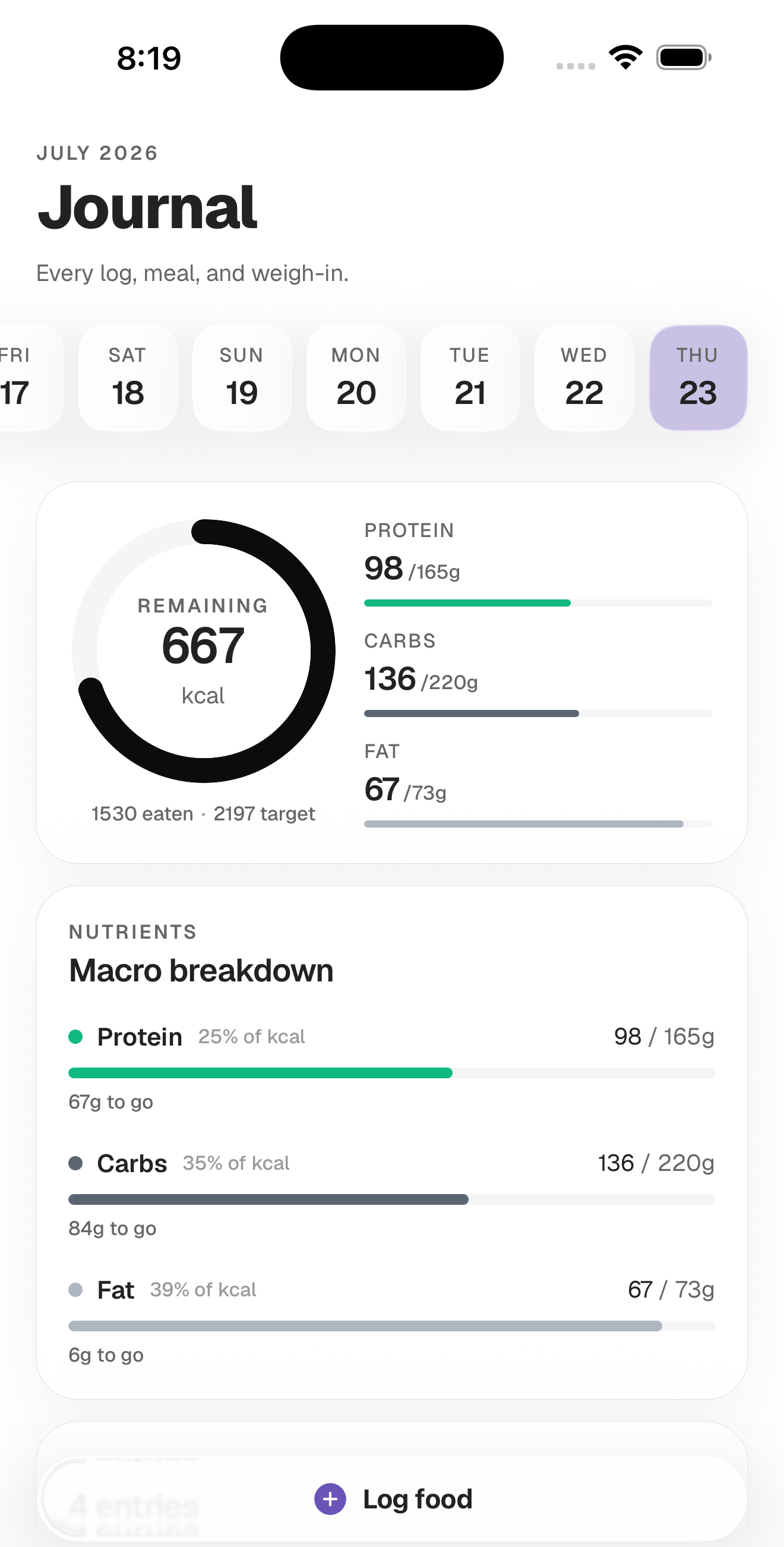
The fix is a rule you decide now: a missed meal gets a guess, entered late, never revisited. "Sandwich and crisps, 600" recorded at 9pm keeps the week honest and keeps the diary alive; a blank does neither. Corvex keeps the week as a strip of days so you can tap back and drop in that estimate without losing your place in today. And if you have already lost a week, do not reconstruct it — log the next thing you eat and leave the gap.
- Decide your missed-meal rule before you need it.
- A late guess beats a blank every time.
- Never rebuild more than yesterday from memory.
What this guide does not cover
It does not set targets. How many calories to aim for is a separate question — start with maintenance calories — and you do not need a target to start a diary at all. It also does not cover diaries kept for medical reasons: logging for suspected intolerances, IBS, allergies or diabetes management needs different fields, different detail, and a clinician reading it with you.
And if writing down what you eat makes you anxious about eating, stop and speak to a clinician or a registered dietitian. A food diary is a neutral tool for many people and not a neutral tool for everyone.
FAQ
How long should I keep a food diary?
Two weeks will show you your patterns. Whether you keep going depends on your goal — if you are working toward a specific calorie target, ongoing logging is what makes it measurable; if you were after awareness, you may get what you needed and stop.
What if I do not know what was in a restaurant meal?
Estimate from the closest thing you can find and move on. A restaurant entry might be 200 calories off; a missing entry is 100% off. Directional accuracy over a week beats false precision on one dinner. Do log drinks with calories, though — juice, alcohol and milky coffees are the easiest things to consume without noticing.
Is a food diary the same as calorie counting?
No. A diary is a record of what you ate; calorie counting adds numbers to that record. You can keep a useful diary without counting anything, and many people should start that way.
Sources
- [1] Burke LE, Wang J, Sevick MA. “Self-monitoring in weight loss: a systematic review of the literature” (2011) — Journal of the American Dietetic Association 111:92–102 (PMID 21185970)
- [2] FoodData Central — USDA food composition database — U.S. Department of Agriculture, Agricultural Research Service
General nutrition information, not medical advice. Calorie and macro targets are estimates — talk to a doctor or a registered dietitian before changing your diet, especially if you are pregnant, managing a health condition, or have a history of disordered eating.
Get the app
Open Corvex on your iPhone
Track calories, weight, and macros in a daily log you will actually keep — then share progress stickers in one tap.