Guide
Simple calorie tracking habits that stick
Nobody quits tracking because the maths got hard. They quit because the app became a task. Four habits that remove decisions from logging — plus why an imperfect eight weeks beats a perfect fortnight, and the exact moment most people stop.
Updated 2026-08-12By Chris RichardsAll guides
Why consistency is the only variable that matters
The systematic review evidence on self-monitoring in weight management is fairly consistent on one point: how regularly people record intake tracks with their outcomes. Not how precisely. How regularly.
The arithmetic makes this obvious. Someone who logs five days a week for eight weeks produces 40 logged days; someone who logs flawlessly for two weeks and then quits produces 14. The second person had better data on every individual day and a fraction of the useful information at the end. Weight change responds to average intake sustained over weeks, so a record with honest gaps still describes your average — a record that stops describes nothing.
Each habit below removes one decision from the logging loop, because decisions are where the habit leaks.
Habit 1 — log before you leave the table
Recall decays fast and it decays in one direction: downward. By the evening you will remember the sandwich and forget the handful of crisps, the second flat white, and the two spoons of your kid's pasta. Logging while the plate is still in front of you removes the reconstruction problem entirely.
Attach it to something that already happens rather than to an intention. "After I put my fork down, I log" is a rule; "I'll log more consistently" is a wish. If you cannot log at the table, log while the kettle boils — the point is a fixed anchor, not a fixed time.
Habit 2 — save your repeats and stop re-solving them
Most people's weeks are remixes of the same eight to twelve meals. If you search for the same breakfast 200 times a year, you have spent real time re-solving a problem you already solved. Spend twenty minutes once: log your standard breakfast, your usual lunches, your rotating dinners and your regular snacks, then save them. In Corvex the log sheet offers recents alongside barcode scanning, a described-meal lookup and manual entry — recents is the one that should carry most of your week.
- Save the whole meal, not the ingredient list, when you eat it the same way every time.
- Anything you eat more than twice a month deserves to be saved.
Habit 3 — protect one protein anchor a day
Pick one protein-forward item you will include most days — eggs, Greek yoghurt, chicken, tofu, lentils, a shake. It becomes a default rather than a daily choice, and it reliably pulls the hardest macro target toward where you want it.
This is a decision-fatigue habit more than a nutrition one: when the anchor is fixed, the only open question at each meal is what goes with it. If you want an actual protein number rather than a habit, work it out with the macro calculator — but the anchor works whether or not you assign a target.
Habit 4 — a 20-second close at night
Once a day, open the log and close the loops. Not to critique the day — to finish it. Anything missing gets a rough estimate rather than a blank; anything you logged as a guess at lunchtime can stay a guess.
This is the habit that saves the week, because it converts "I forgot to log lunch, the day is ruined" into a ten-second repair. Set it against something you already do at a fixed time: brushing your teeth, plugging in your phone, closing the laptop.
The failure mode: the fourth Saturday
The break almost never happens on a Tuesday. It happens on a weekend, at a meal you cannot estimate — a dinner out, someone's birthday, a long lunch — and the response is to not log at all. Monday then feels like starting over, so Monday gets skipped too, and by Wednesday the app is a source of guilt rather than information.
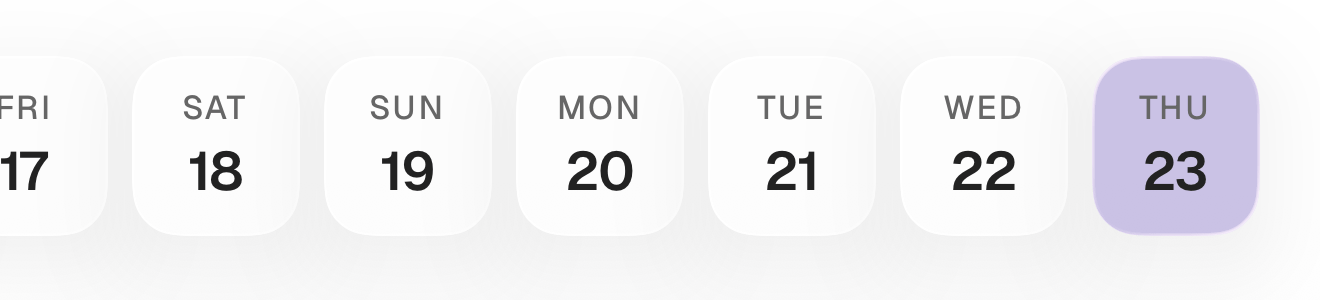
Treat the streak as a readout on whether your system fits your life, never as identity. People protect the number by logging fictional days, or abandon the app after breaking a 60-day run because the record is "ruined". Corvex shows the week as a strip of days precisely so a single gap reads as one grey square rather than a failure state.
The recovery has one rule: log the unloggable meal as a guess. Write "restaurant dinner, 900" and move on. A number invented in good faith keeps your weekly average roughly honest and keeps the chain of days unbroken; a blank does neither. And if you have already lost a week, do not backfill it — open the app, log today's next meal, and let the gap stay a gap.
- A rough estimate always beats a blank entry.
- Restart on the same day you notice, not on Monday.
- Never backfill more than yesterday.
What this guide does not cover
These are adherence habits, not a nutrition plan. They will not tell you what to eat or how many calories to aim for — for the target-setting side, start with maintenance calories and adjust from there. They also assume tracking is a neutral activity for you. If logging food increases anxiety around eating, more habit engineering is the wrong answer; talk to a clinician or a registered dietitian instead.
FAQ
How long until logging feels automatic?
For most people the search-and-tap part stops feeling effortful within two to three weeks, mostly because their regular meals are saved by then. Remembering to open the app at all is the slower habit — that one is helped far more by anchoring it to an existing routine than by willpower.
Is it worth logging a day I know went badly?
Yes, and those are the most valuable days in the record. A log that only contains your good days describes a person who does not exist and gives you an average that is quietly wrong.
Should I track macros too, or just calories?
Just calories at first, and protein once that feels boring. Adding three targets on day one is a reliable way to make logging feel like admin. Macros are worth adding later, when opening the app costs you nothing.
Sources
- [1] Burke LE, Wang J, Sevick MA. “Self-monitoring in weight loss: a systematic review of the literature” (2011) — Journal of the American Dietetic Association 111:92–102 (PMID 21185970)
- [2] Hall KD, Sacks G, et al. “Quantification of the effect of energy imbalance on bodyweight” (2011) — The Lancet 378:826–837 (PMID 21872751)
General nutrition information, not medical advice. Calorie and macro targets are estimates — talk to a doctor or a registered dietitian before changing your diet, especially if you are pregnant, managing a health condition, or have a history of disordered eating.
Get the app
Open Corvex on your iPhone
Track calories, weight, and macros in a daily log you will actually keep — then share progress stickers in one tap.