Guide
Share weight progress on your terms
Sharing progress can make a habit stick or make it about performance. The difference comes down to who sees it, what you show, and whether you can stop. Here is a practical framework — including what not to put in a post, and when not to post at all.
Updated 2026-08-12By Chris RichardsAll guides
Decide the audience before you make anything
One friend, a close-friends story, a group chat and a public feed are four different decisions, and people routinely make the fourth by accident because it is the default button. Choose deliberately, before you have something you are excited to post.
For accountability, small beats large. One person who will ask on Sunday whether you logged is more useful than four hundred followers who like a post and forget it. A large audience adds a second, unrelated motivation — being seen doing well — and that one survives right up until a bad week, which is when you need accountability most.
- One accountability partner: highest value, lowest exposure.
- Close friends or a group chat: good for weekly summaries.
- Public feed: choose it on purpose, or not at all.
Share the process, not the body
The most shareable things in a tracking app are also the safest, which is a convenient coincidence. Consistency of self-monitoring is the behaviour with actual evidence behind it in weight-management research, so sharing the logging rather than the outcome is not a softer post — it is a more accurate one. Weight, in any given week, is partly something you did not control.
- A streak or consistency figure — logged 6 of 7 days.
- A target you set yourself and hit, like protein on 5 days.
- A habit you kept: trained three times, cooked at home four nights.
- A meal you were pleased with, no numbers attached.
A worked example of a weekly share
Say your week looked like this: you logged food on 6 of 7 days, your logged intake averaged 2,050 against a 2,100 target, and you hit your protein number on 5 days.
The share writes itself from the process figures: "6 of 7 days logged, protein hit 5 times, average within 50 of target." Every number there is a behaviour, so it reads as a report on a system and invites the useful kind of reply — how are you finding it, what are you cooking.
The version to avoid is the same week reframed as an outcome: a weight figure, a goal figure, and the gap between them. That invites comparison, hands anyone reading it a number to measure themselves against, and obliges you to post an update when the number moves the other way. Same week, very different post.
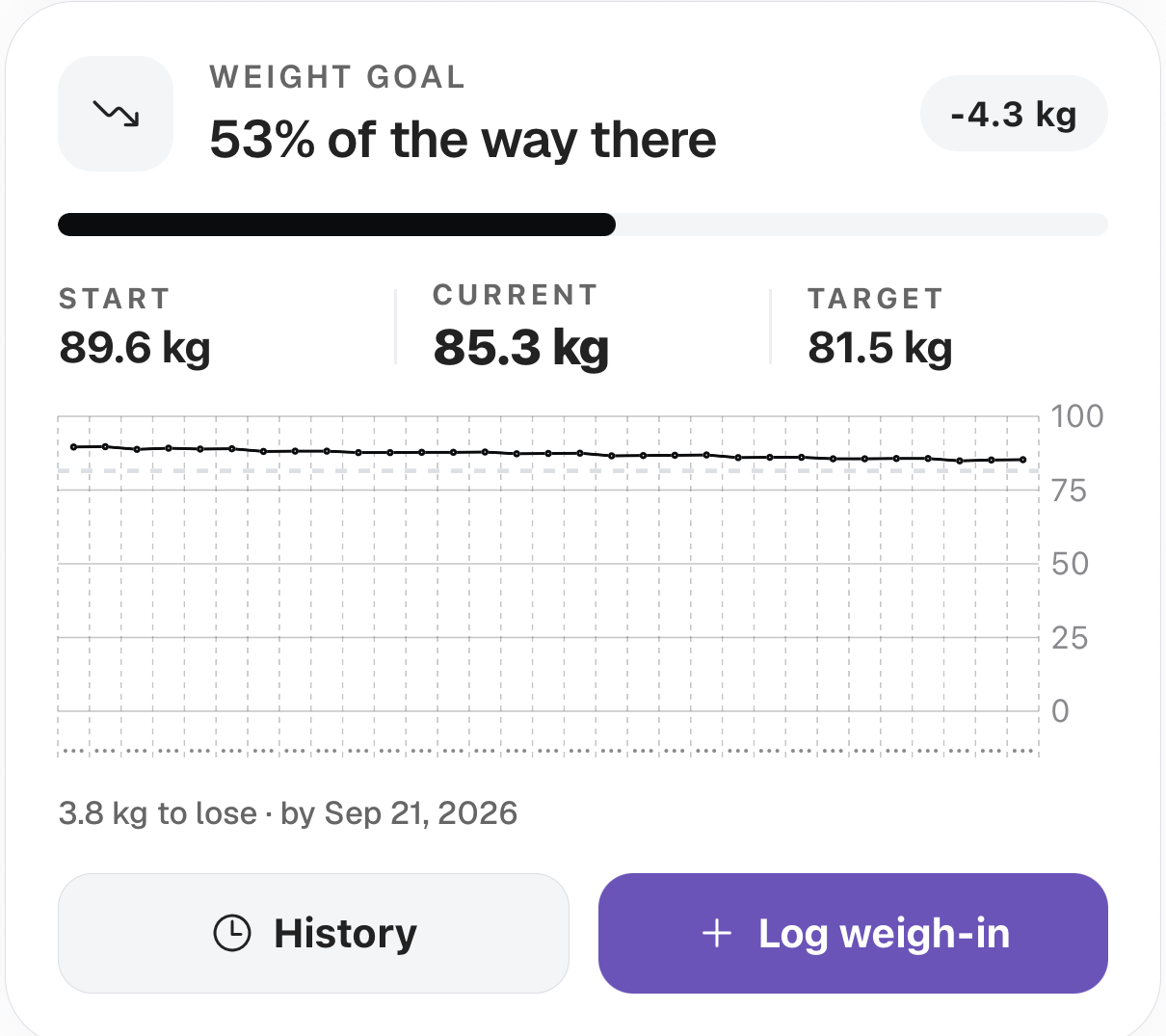
Corvex exports progress stickers for Instagram Stories, Snapchat and TikTok covering calories, macros, weight and streaks — and which you pick is the real decision. Streak and macro stickers say something about what you did; a weight sticker says something about your body, which is a higher-exposure choice worth making consciously.
Rules that protect the people reading
Anything you post lands in front of people whose relationship with food and their body you know nothing about. A few conventions cost you nothing and matter a lot — and the general test behind all of them is simple: could this be read as an instruction? If so, cut the numbers and keep the behaviour.
- No before/after body shots, and no goal or start weights — a number that suits you is meaningless for someone else's body, and will be read as a standard however you frame it.
- No moralising vocabulary about food: no "clean", no "cheat", no "earned it".
- No calorie counts stapled to meal photos.
- Say what you did, not what someone else should do.
The failure mode: the post becomes the point
Sharing starts as accountability, gets a good response, and gradually becomes the reason for the behaviour. The tells: you feel obliged to post every week, a quiet week feels like something to hide, you catch yourself timing a weigh-in for a better number.
The recovery is to remove the audience temporarily, not to post more carefully. Stop sharing for a month and keep logging exactly as before. If the habit survives, sharing was a bonus and you can reintroduce it deliberately. If it collapses, the audience was doing the work — worth knowing before you build anything on top of it.
When not to share at all
Some situations make sharing a bad idea regardless of technique: an audience that includes someone unwell around food, a family member who comments on your body, or a previous attempt that went badly. Those are sufficient reasons not to, and you do not owe anyone an explanation.
A plainer line: if preoccupation with weight, body shape, or controlling intake is becoming a fixation, adding an audience makes that harder, not easier. The NIMH overview of eating disorders describes those warning signs and how to find help. That is a conversation with a clinician, not a decision about post format. None of this makes sharing inherently risky — for plenty of people a weekly note to one friend is the single thing keeping the habit alive. It just deserves five seconds of thought rather than a reflex.
What this guide does not cover
It is not advice on building an audience, growing a fitness account, or monetising progress content — different activities with different incentives, and the framing above works against most of them on purpose. It also does not address sharing data with a clinician, coach or dietitian: that is full detail, no editing, no audience, and should be judged on accuracy rather than exposure.
FAQ
Does sharing progress actually help?
It can, mostly by adding an external reason to keep recording — and consistency of recording is the part with research behind it. The effect comes from a small number of people who will actually follow up, not from reach.
What should I share instead of a weight number?
How many days you logged, whether you hit a target you set yourself, or a habit you kept. All are things you controlled and none invite comparison. Weekly is frequent enough; daily posting turns a private habit into a performance with a deadline.
A friend asked me for my calorie target. Should I give it?
Better to share the method than the number. Your target came from your body, your activity, and your goal — point them at a maintenance estimate they can run for themselves rather than a figure that was never calculated for them.
Sources
- [1] Zheng Y, Klem ML, et al. “Self-weighing in weight management: a systematic literature review” (2015) — Obesity 23:256–265 (PMID 25521523)
- [2] Burke LE, Wang J, Sevick MA. “Self-monitoring in weight loss: a systematic review of the literature” (2011) — Journal of the American Dietetic Association 111:92–102 (PMID 21185970)
- [3] Eating Disorders — overview, warning signs, and getting help — National Institute of Mental Health (NIH)
General nutrition information, not medical advice. Calorie and macro targets are estimates — talk to a doctor or a registered dietitian before changing your diet, especially if you are pregnant, managing a health condition, or have a history of disordered eating.
Get the app
Open Corvex on your iPhone
Track calories, weight, and macros in a daily log you will actually keep — then share progress stickers in one tap.