Guide
Daily weigh-ins that inform — not punish
A single morning number is mostly noise. Weighed daily and averaged weekly, the same number becomes the most useful feedback you have. This guide gives you the ritual, the arithmetic for reading a week of readings, the spiral day that derails people, and an honest account of who should not do this at all.
Updated 2026-08-16By Chris RichardsAll guides
What the scale is actually measuring
A bathroom scale measures everything gravity acts on: tissue, but also the water in your muscles, the food still moving through you, and the glycogen stored from yesterday's carbs with roughly three grams of water attached to each gram. Sodium, alcohol, a late meal, hard training, illness and cycle phase all move the reading, often by a kilogram within days — none of it fat, all of it visible. Real change in body tissue is slow by comparison, and the modelling work on energy imbalance makes the point that body-weight change lags intake change by a long way. So the daily number is not a verdict. It is one noisy sample, and the value of weighing daily is that seven noisy samples average into something much quieter than one.
The ritual: same time, same conditions, log once
Consistency of conditions matters more than the scale being accurate in absolute terms. A scale that reads 400 g heavy is fine — the offset cancels out when you compare this week to last week. What ruins the data is weighing after breakfast on Tuesday and before it on Wednesday. Do it in this order, every day, and it takes fifteen seconds.
- Wake up, use the bathroom, then weigh — before eating or drinking.
- Same scale, hard floor, minimal or no clothing.
- Step on once. Do not step off and re-weigh to get a nicer number.
- Log it immediately, before you have formed an opinion about it.
- Look at the daily number for one second. Look at the 7-day average once a week.
A worked example: reading two weeks of readings
Here is a real-shaped fortnight. Week one, in kilograms: 78.4, 78.9, 78.6, 79.2, 78.5, 78.3, 78.7. Those seven add to 550.6, so the average is 78.66 kg.
Week two: 78.2, 78.6, 78.1, 78.4, 78.0, 78.3, 77.9. Those add to 547.5, so the average is 78.21 kg.
The change that matters is 78.66 − 78.21 = 0.45 kg over the week. Now look at what a day-to-day reader would have seen instead. Inside week one alone the readings spanned 78.3 to 79.2 — a 0.9 kg range, twice the size of the entire fortnight's real movement. On Thursday of week one this person was "up 0.9 kg" and on Saturday "down 0.9 kg", and neither event happened.
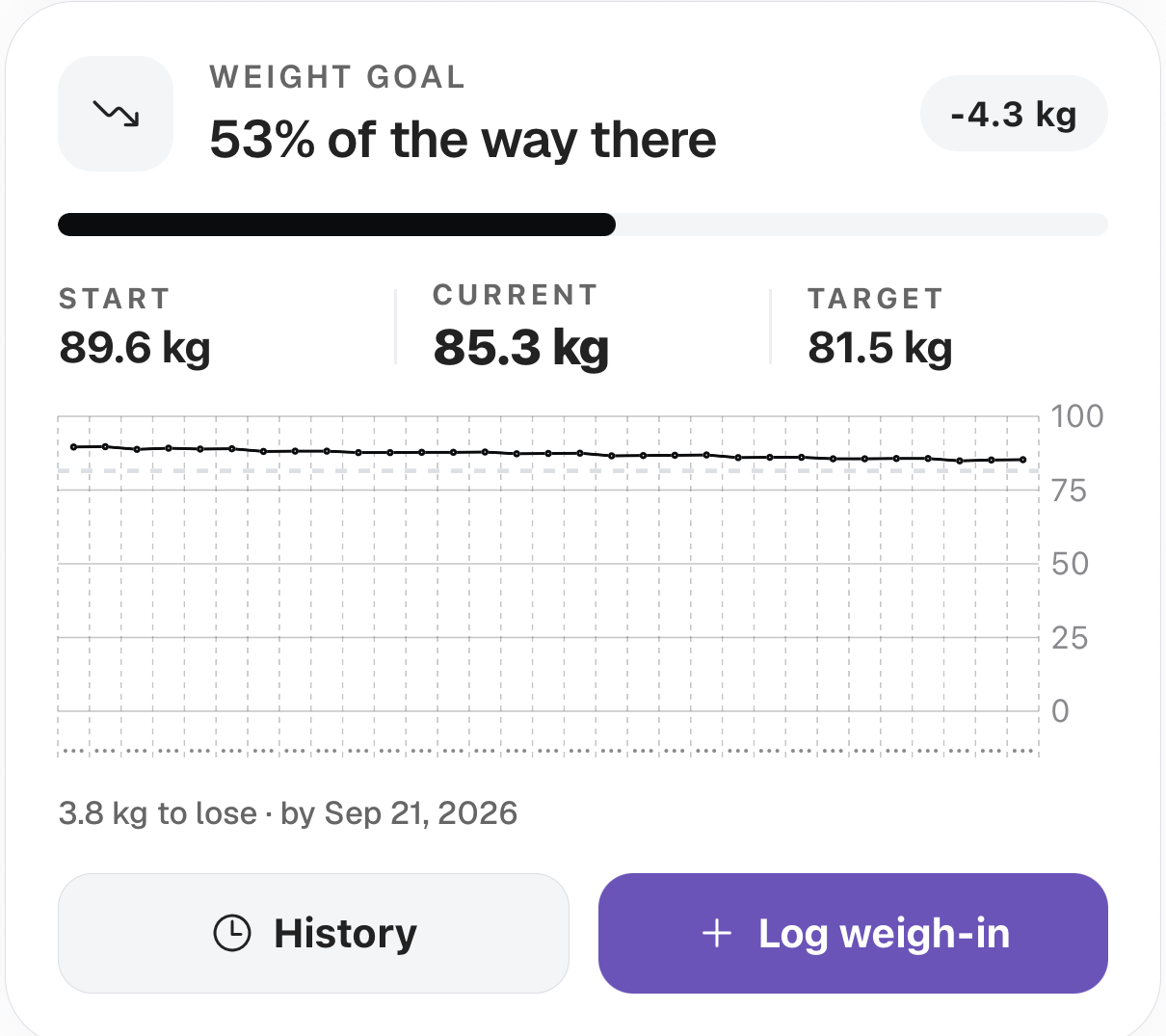
That gap between noise and signal is the whole argument for daily weighing: you are not collecting daily numbers to react to them, but so the average has enough data to be trustworthy. Corvex plots weigh-ins as a trend line for exactly this reason — the daily dots stay visible, but the line is what you read.
The failure mode: the spiral day, and how to get out of it
The predictable failure is not forgetting to weigh. It is the morning the number goes the wrong way and the rest of the day gets rewritten around it — you skip breakfast to "make up for it", train harder than planned, eat too little by 4pm, then eat past your intake target at 9pm because you were running on nothing. The scale caused a real energy problem out of a fake one.
The recovery is mechanical, not motivational. If a reading upsets you, do three things in order and do not negotiate: do not change today's food plan, because it was set before you knew the number; open the 7-day average and read that instead; and if the average has moved less than about 0.2 kg either way, accept that you have no new information and no decision to make. If you find yourself spiralling more than occasionally, that is the signal to reduce weighing frequency — not to try harder at being calm about it.
Daily weighing is not right for everyone
This is worth saying plainly rather than burying: for some people a daily number is actively harmful, and no amount of good technique fixes that. The systematic literature on self-weighing reports a benefit for awareness on average, but averages describe groups, not you. Weekly weighing carries almost all of the same trend information with a seventh of the emotional exposure, and clothing fit, training performance and your food log are legitimate progress signals on their own.
If preoccupation with weight, body shape, or controlling intake is becoming a fixation, or if weighing is something you feel compelled to do, that is a reason to stop and speak to a clinician rather than to optimise the ritual. The NIMH overview of eating disorders describes those warning signs and where to get help.
- Pause daily weighing if the number sets your mood for the day.
- Weekly or fortnightly weighing is a complete strategy, not a downgrade.
- Not weighing at all is also a complete strategy.
What this guide does not cover
It does not tell you what to weigh. There are no target weights here on purpose — a number that suits one person is meaningless for another. It also does not cover body composition: a scale cannot separate muscle from fat from water, so if you are training hard it can stall for weeks while your body genuinely changes.
And it is not medical guidance. If you are pregnant, recovering from illness, taking medication that affects fluid balance or appetite, or managing a diagnosed condition, ask a clinician how — and whether — to monitor weight.
FAQ
Should I weigh every day?
Only if it stays emotionally neutral. Daily readings give the cleanest weekly average because seven samples smooth out water and food weight. But weekly weighing captures nearly the same trend, and if daily numbers affect your mood or your eating, weekly is the better tool.
The scale went up overnight. Did I gain fat?
Almost certainly not. An overnight jump of half a kilo to a kilo is usually water, glycogen, sodium, or food still in transit. Gaining that much actual tissue would take a sustained energy surplus over many days, not one evening.
How long before a new average means something?
Give it two to three weeks. One week of averages can still be moved by a single unusual few days. If the trend has held its direction across three weekly averages, it is real enough to act on.
Sources
- [1] Zheng Y, Klem ML, et al. “Self-weighing in weight management: a systematic literature review” (2015) — Obesity 23:256–265 (PMID 25521523)
- [2] Hall KD, Sacks G, et al. “Quantification of the effect of energy imbalance on bodyweight” (2011) — The Lancet 378:826–837 (PMID 21872751)
- [3] Eating Disorders — overview, warning signs, and getting help — National Institute of Mental Health (NIH)
General nutrition information, not medical advice. Calorie and macro targets are estimates — talk to a doctor or a registered dietitian before changing your diet, especially if you are pregnant, managing a health condition, or have a history of disordered eating.
Get the app
Open Corvex on your iPhone
Track calories, weight, and macros in a daily log you will actually keep — then share progress stickers in one tap.