Compare
Cronometer vs Corvex
Neither of these is a worse version of the other. Cronometer is a nutrition instrument that also counts calories. Corvex is a daily habit that also happens to be beautiful. The question is which job you are actually hiring an app to do.
Updated 2026-08-12By Chris RichardsAll comparisons
Corvex wins
- Repeat-meal logging is free, not a paid feature
- No ads on any tier
- Weight trends as a first-class screen
- One-tap progress stickers
Cronometer wins
- Genuine micronutrient depth, not a token vitamins tab
- A curated database instead of a user-submitted free-for-all
- Wide wearable and health-device sync
- Runs on Android and beyond iOS
Verdict
Cronometer wins for micronutrient precision and data quality. Corvex wins for a daily calorie, macro, and weight habit you will keep, with progress worth sharing.
Best for: People who want clarity in a day view rather than a nutrient panel to interpret.
What Cronometer is actually built for
Most calorie trackers treat micronutrients as a footnote — a tab you open once and never return to. Cronometer inverts that. Its App Store listing describes tracking calories, protein, carbs, fat and fibre alongside support for 95+ vitamins and minerals, measured against personalised targets rather than a generic percentage bar.
The other half of the pitch is the catalogue. Cronometer describes a curated database of more than 1.1 million verified foods. That number looks small next to the tens of millions other apps advertise, and that is the point: it is smaller because entries are vetted rather than crowd-submitted. If you have ever picked the wrong "chicken breast" out of six near-identical results, you understand the trade.
What it costs, and what the free tier holds back
Cronometer is free to start. On the US App Store, its in-app purchases list Gold Monthly at US$10.99 and Gold Annual at US$59.99. Prices differ by region and promotion, so check the figure your own store shows rather than the one on any comparison page, including this one.
The more useful question is where the free line sits. Cronometer places photo and voice logging, the fasting tracker, the recipe importer, repeat items and an ad-free experience behind Gold.
- Repeat items — re-logging the meal you already ate on Tuesday — sits on the paid side. For most people that is the single most-used action in a tracker.
- The free tier carries ads. If ads are the reason you started looking, this is the relevant line, not the price.
- Everything else on the free tier is real. This is not a trial dressed up as a free plan.
Where Cronometer is clearly better
These are not concessions for balance. They are reasons to close this page and go subscribe.
- Micronutrient depth. Nothing in the design-led corner of this category comes close, and Corvex does not try to.
- Data quality. A vetted database is worth more than a vast one if you care whether the number is right.
- Device breadth. Its listing names Apple Health, Apple Watch, Fitbit, Garmin, Oura and Whoop among its syncs.
- Platform reach. Cronometer is on Google Play as well as the App Store. Corvex is iOS-only today, so if you are on Android this comparison ends here.
- Working with a professional. If a dietitian or clinician wants to see your intake, a nutrient-complete export is a better thing to hand over than a screenshot.
Where Corvex is different
Corvex starts from a different premise: that the limiting factor is not how much the app measures, but whether you still open it in week six.
- Four ways into a log — describe the meal in plain words, scan a barcode, pull from recents, or type macros by hand — from one sheet, one tap from every screen.
- Recents and saved meals are free. Repeating yesterday is the fastest path through a tracker and it should not be a paid tier.
- Weigh-ins roll into a trend line with start, current and target always visible, rather than a chart you go looking for.
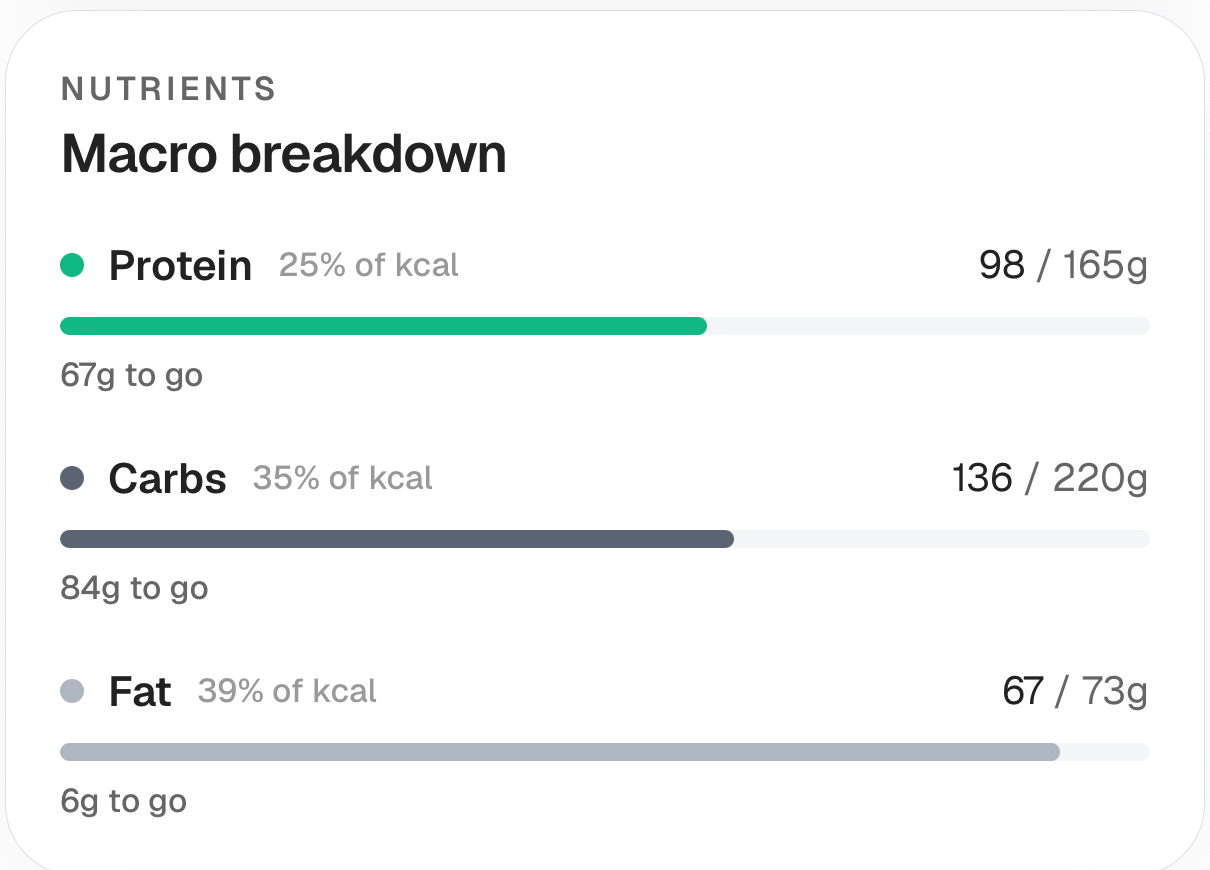
- Macros as a share of the day with grams still to go, and fibre tracked alongside without being folded into the calorie maths.
- Share stickers for streaks, weight and macro days, built for Stories rather than for screenshotting.
- No ads on any tier. Premium adds longer history, advanced charts and the full sticker library.
Precision you will use beats precision you will not
There is an honest version of the accuracy argument that rarely gets made. A nutrient panel you fill in accurately three days a week tells you less than a rough calorie and weight log you keep for three months. Consistency of self-monitoring, not granularity, is the variable that keeps showing up in the research on weight management.
That is not an argument against Cronometer. It is an argument for being truthful with yourself about which app you will actually open on a Wednesday night. If the answer is the detailed one, use the detailed one — the depth is real and free to try.
So which should you pick?
Choose Cronometer if micronutrients are the reason you are tracking at all: a deficiency you are managing, a restricted diet you need to check for gaps, an athlete cutting weight, or a professional reviewing your intake. Choose it also if you are on Android.
Choose Corvex if you already know roughly how you want to eat, you want calories, macros and weight in one calm view, you want repeat logging free, and you want the app to be pleasant enough that opening it is not a decision.
FAQ
Is Cronometer free?
There is a real free tier, but it carries ads, and photo and voice logging, the fasting tracker, the recipe importer and repeat items are listed as Gold features. Corvex has no ads on any tier and keeps repeat logging free.
Does Corvex track micronutrients?
No. Corvex tracks calories, protein, carbs, fat and fibre. If you need vitamins and minerals at the level Cronometer provides, Corvex is the wrong tool and we would rather say so than imply otherwise.
How much does Cronometer Gold cost?
On the US App Store its in-app purchases are listed as US$10.99 monthly and US$59.99 annually. Regional pricing and promotions vary, so confirm in your own store.
Can I move my Cronometer history into Corvex?
Not in v1 — there is no import. Export your Cronometer data for your own records before you stop using it, and expect to rebuild your regular meals in Corvex over about a week of normal eating.
Is Cronometer more accurate than other trackers?
Its database is curated rather than user-submitted, which reduces the wrong-entry problem that larger crowd-sourced catalogues have. That is a real advantage for data quality. It does not fix portion estimation, which is where most tracking error actually comes from.
Sources
- [1] Cronometer: Calorie Counter — App Store listing (in-app purchases: Gold Monthly US$10.99, Gold Annual US$59.99; 95+ vitamins and minerals; 1.1 million verified foods) — Apple App Store, US storefront (checked 12 August 2026)
- [2] Burke LE, Wang J, Sevick MA. “Self-monitoring in weight loss: a systematic review of the literature” (2011) — Journal of the American Dietetic Association 111:92–102 (PMID 21185970)
General nutrition information, not medical advice. Calorie and macro targets are estimates — talk to a doctor or a registered dietitian before changing your diet, especially if you are pregnant, managing a health condition, or have a history of disordered eating.
Get the app
Open Corvex on your iPhone
Track calories, weight, and macros in a daily log you will actually keep — then share progress stickers in one tap.