Essay
Aesthetic vs clinical tracking apps
These are not two qualities of the same product. They are two different products answering two different questions, and most people pick the wrong one because they answer a question they do not have.
Updated 2026-08-12By Chris RichardsAll posts
Two products, two questions
A clinical tracker answers "exactly what did I consume". An aesthetic tracker answers "am I still doing this in six weeks". Both are legitimate questions. Only one of them is your bottleneck at any given time, and you should buy for the bottleneck.
The confusion comes from the fact that both categories advertise as calorie trackers, so they look substitutable on the App Store. They are not. Choosing a clinical tool when your problem is adherence is like buying a torque wrench because the shelf keeps falling down.
What clinical density actually buys you
It is worth being specific rather than treating "clinical" as a vibe. Cronometer states on its homepage that it tracks up to 95 different nutrients and compounds against a database of over 1M verified foods, and leans hard on lab-analysed data. MyFitnessPal advertises 20.5 million foods. Those two numbers describe opposite strategies: verified depth versus crowd-sourced breadth.
The depth is real and it matters in real situations. Iron on a plant-based diet. Sodium and potassium with hypertension. Vitamin K if you are on warfarin. Fibre and specific micronutrients after bariatric surgery. A cutting phase where an athlete needs protein hit within a narrow band every single day. In all of those, a number being approximately right is not good enough, and a tracker that shows you calories and three macros is not the right instrument.
The cost is density. Ninety-five nutrients means a screen with ninety-five things on it, which is exactly right when you are auditing a diet and exactly wrong when you are trying to build a habit at 7am.
What design buys you, stated without romance
The case for aesthetic tracking is not that beauty is nourishing. It is narrower and more mechanical: an app you do not mind opening gets opened, and an app that gets opened produces data. A perfect record you stopped keeping in week two describes nothing.
What "aesthetic" should mean in practice is a hierarchy decision, not a colour palette. One number is the headline. Macros sit under it. Weight is a trend line rather than a reading. Fibre is tracked but is not folded into the calorie arithmetic where it would confuse the total. Everything else is one tap away instead of on the screen. That is design doing work, and it is a harder engineering problem than adding another column.
For most people the honest nutritional requirement is simple: total calories in a defensible range and enough protein. The Dietary Reference Intakes put protein at 10–35% of energy with an RDA of 0.8 g/kg — a target you can hit while looking at three numbers, not ninety-five.
Both categories have a failure mode
Clinical tools fail by attrition. The interface is a spreadsheet, logging feels like data entry, the micronutrient panel you were going to review every week goes unreviewed by week three, and eventually the app is deleted having produced a very precise eleven-day record.
Aesthetic tools fail by flattery. A calm, well-typeset number is more believable than an ugly one, and that persuasiveness is not backed by anything — a beautiful estimate is still an estimate. If a tracker never surfaces its own uncertainty, it is asking you to trust a design decision as if it were a measurement. The defence is external: weigh yourself regularly and let the trend audit the calorie figures. If intake says deficit and the trend says otherwise, the trend is right.
Anyone claiming their category has no failure mode is selling.
How to tell which one you need
Pick the side of this list you land on more often. If it is genuinely both, use a clinical tool for a two-week audit and a daily tool for the other fifty weeks.
- Choose clinical if a clinician, a medication, or a competition has given you a specific target for a specific nutrient.
- Choose clinical if you have a diagnosed condition where a micronutrient matters, or a restrictive diet where deficiencies are plausible.
- Choose aesthetic if your track record is starting and abandoning trackers — that is an adherence problem, and more columns have never once fixed one.
- Choose aesthetic if you eat mostly the same things and already broadly know how you should be eating.
- Choose aesthetic if the reason you stopped last time was that the app was unpleasant to open.
Corvex’s bet, stated plainly
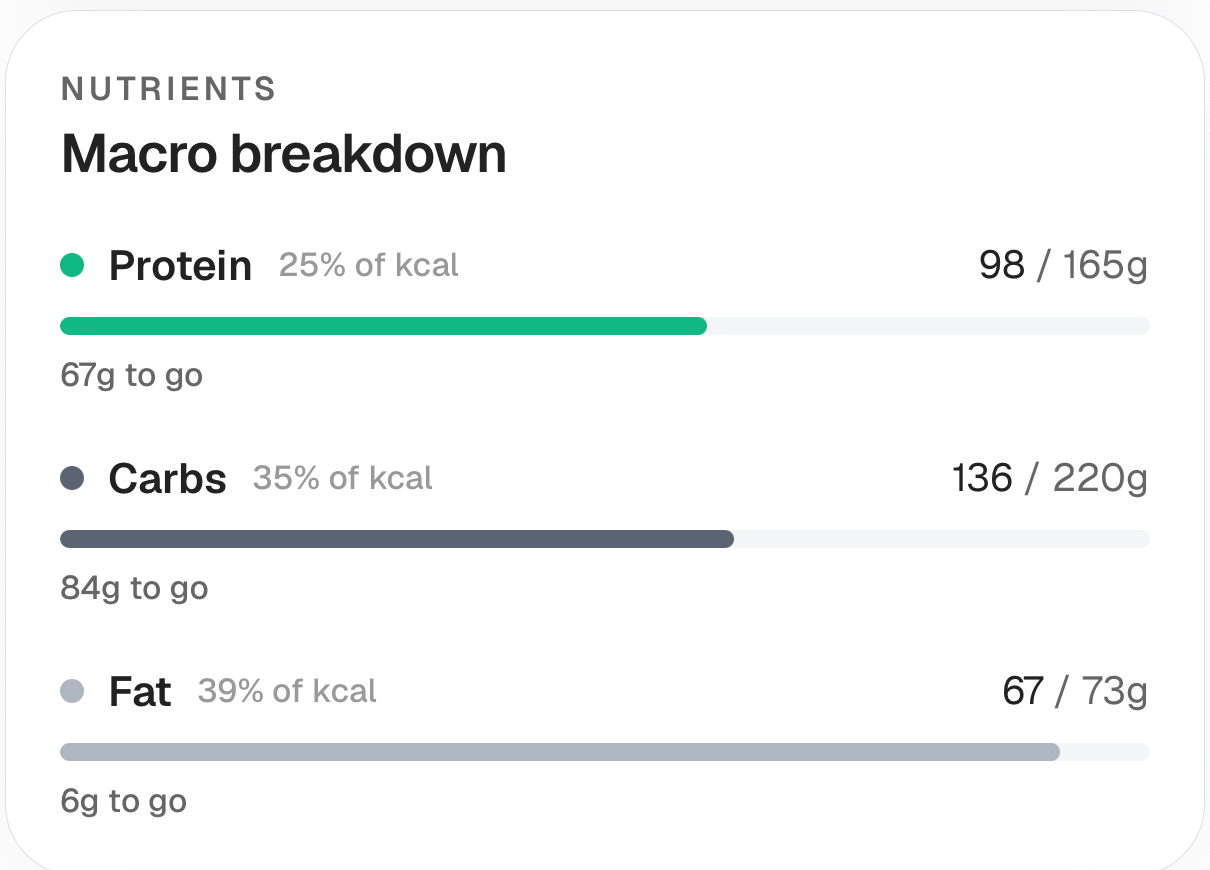
We built the second thing, deliberately, and we are not neutral about it. Corvex shows calories, protein, carbs and fat, tracks fibre alongside them, and treats weight as a trend line with the week always in view. There is no micronutrient panel and there is not going to be one.
The bet is that most people who fail at tracking do not fail for want of a manganese column. They fail because the ritual is joyless. If your situation genuinely calls for lab-analysed micronutrient depth, Cronometer is a better tool than ours and you should use it — that is a real recommendation, not a rhetorical concession.
FAQ
Do I need to track micronutrients?
Most people building a general calorie habit do not, at least not daily. It becomes worth doing when a restrictive diet, a medication interaction, a diagnosed deficiency or a clinician’s instruction makes a specific nutrient consequential. A periodic audit in a clinical tool covers that better than daily tracking in a simple one.
Is a minimalist tracker less accurate?
Not inherently. Accuracy depends on what you log and how consistently, not on how many fields are visible. What a minimalist tracker gives up is coverage of nutrients it does not show — which only costs you if you needed them.
Can I use both a clinical and an aesthetic tracker?
Yes, and it is a sensible pattern: a detailed audit for a fortnight when something changes, and a lightweight daily log the rest of the time. Duplicating both every day is a workload almost nobody sustains.
Sources
- [1] Acceptable Macronutrient Distribution Range (protein 10–35% of energy; RDA 0.8 g/kg) — National Academies of Sciences, Engineering, and Medicine — Dietary Reference Intakes
- [2] Cronometer homepage — “Track up to 95 different nutrients and compounds”, “a database of over 1M verified foods” — Cronometer (checked 12 August 2026)
- [3] MyFitnessPal homepage — “20.5M Foods” — MyFitnessPal (checked 12 August 2026)
General nutrition information, not medical advice. Calorie and macro targets are estimates — talk to a doctor or a registered dietitian before changing your diet, especially if you are pregnant, managing a health condition, or have a history of disordered eating.
Get the app
Open Corvex on your iPhone
Track calories, weight, and macros in a daily log you will actually keep — then share progress stickers in one tap.