Guide
How to track macros without living in a spreadsheet
Macros are not a fourth thing to track on top of calories — they are the calorie number split three ways. Here is the conversion arithmetic, a worked example turning one calorie target into three gram targets, how much protein the evidence supports, and when the third target stops earning its place.
Updated 2026-08-12By Chris RichardsAll guides
A macro is a calorie with a job
Protein, carbohydrate and fat supply essentially all of your energy intake, and each converts to calories at a fixed rate. The Atwater general factors used by food labelling and composition databases worldwide are 4 kcal per gram for protein, 4 for carbohydrate, 9 for fat and 7 for alcohol — which is why a tablespoon of oil costs more than a slice of bread.
That fixed conversion is why macros and calories can never disagree: your total is the sum of your macro totals. Tracking macros is not work stacked on calorie tracking, it is the same log at higher resolution — and that resolution buys you something the total cannot. Two 2,200-calorie days, one at 60 g of protein and one at 140 g, satisfy differently and support training differently.
Order of operations: calories first, protein second, the rest last
The common mistake is starting from a percentage split found online. Percentages are the output of this process, not the input.
- Set the calorie number first, from maintenance calories.
- Assign protein next, in grams per kilogram — the target most people miss.
- Set fat as a percentage; it has a floor rather than an obvious target.
- Give every remaining calorie to carbohydrate, the flexible one by design.
How much protein, honestly
Two numbers get quoted and they answer different questions. The Dietary Reference Intake RDA for protein is 0.8 g per kilogram of body weight per day for adults — a figure set to cover the requirements of nearly all healthy people, which is not the same as optimal for someone lifting weights.
The training literature points higher. A 2018 meta-analysis of 49 studies and 1,863 participants found that protein intakes beyond about 1.62 g/kg/day produced no further gains in fat-free mass from resistance training, with the confidence interval on that break point running from roughly 1.03 to 2.20 g/kg/day. Read honestly, that argues for landing in the 1.6–2.2 g/kg band if you train, and against going past it.
Then check it against the published range: the Acceptable Macronutrient Distribution Range for adults puts protein at 10–35% of energy, carbohydrate at 45–65% and fat at 20–35%.
A worked example: one calorie target, three gram targets
Take someone at 80 kg whose target is 2,200 kcal a day, training three times a week.
Protein first, at 1.6 g/kg: 80 × 1.6 = 128 g, which at 4 kcal per gram is 512 kcal.
Fat next, at 25% of calories: 0.25 × 2,200 = 550 kcal, which at 9 kcal per gram is 61 g. The floor matters here — 20% of calories would be 440 kcal, or 49 g.
Carbohydrate gets what is left: 2,200 − 512 − 550 = 1,138 kcal, which at 4 kcal per gram is 285 g. So the day is 128 g protein, 285 g carbohydrate, 61 g fat.
Now the sanity check. As percentages that is 23% protein, 52% carbohydrate and 25% fat — all inside the AMDR bands. Compare a popular "30/45/25" split on the same calories: 660 kcal of protein is 165 g, or 2.06 g/kg here, past the point where the meta-analysis found further benefit. Rounding, meanwhile, is not worth agonising over — 285 g and 280 g of carbohydrate are the same instruction.
Logging three numbers in the time you logged one
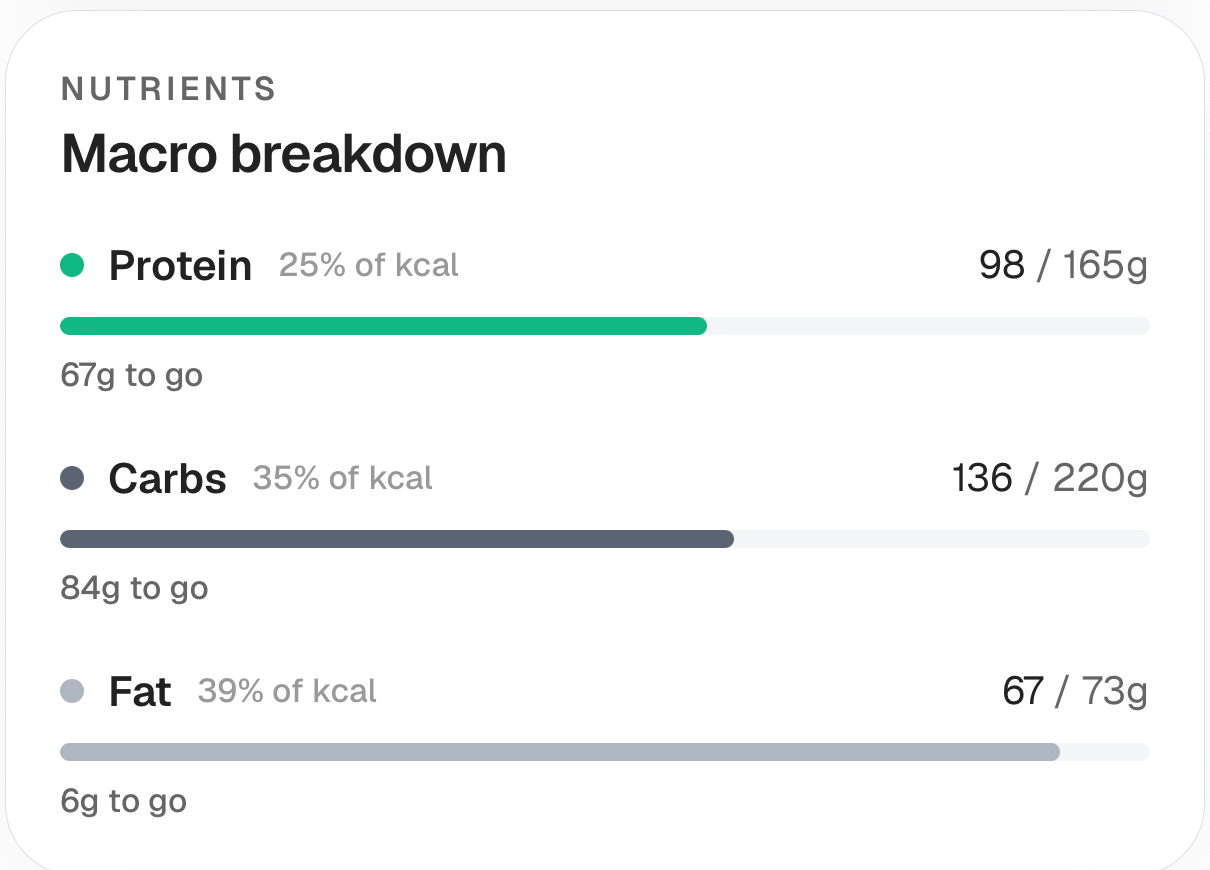
You do not log macros separately — you log food once and the macros come with it. What changes is what you read afterwards. A macro tracker earns its place by showing grams remaining rather than grams eaten, because "67 g of protein to go" is an instruction and "98 g of protein" is a quiz.
The rest is ordinary habit work: save your repeats so weekday meals are two taps, and log at the table rather than reconstructing the day at 9pm. Corvex puts calories and the three macro bars on one daily card.
- Read grams remaining, not grams eaten.
- Check protein at lunchtime, not bedtime — that is when you can still act on it.
The failure mode: three targets, three ways to fail a day
With one target you either hit it or you do not. With three, a day can fail in seven combinations, and there is always one number off. People respond by eating something they do not want at 10pm to close a 12 g gap, which is a worse outcome than the gap.
The fix is to rank them in advance. Protein is a target you hit most days; calories are one you land near; carbohydrate and fat are leftovers, free to move around each other — swapping 20 g of carbohydrate for 9 g of fat changes nothing. The quieter failure is adding macros too early: track calories until logging is boring, then add protein, and leave the other two alone until you have a reason to care.
What this guide does not cover
It does not tell you what to eat: macro targets are arithmetic, food choice is preference and budget. It also says nothing about micronutrients, fibre or food quality — a day can hit all three targets and still be a poor day of eating, which is a real limitation of the approach.
And it is general information, not medical or dietetic advice. Kidney disease, diabetes, pregnancy, eating-disorder history and medications affecting appetite all change how macro targets should be set, or whether to set them at all — a clinician or registered dietitian, not a calculator.
FAQ
Do I need to hit macros exactly?
No. Hit protein most days, land near your calorie target, and treat carbohydrate and fat as ranges rather than pass/fail scores. Your inputs carry real error — label tolerances, portion estimates, variation between one chicken breast and the next — so precision beyond about 10 g is precision about noise.
Is a macro tracker better than a calorie tracker?
They are the same log at different resolutions, so the real question is whether you want the detail today. Calories determine the direction your weight trends; macros shape how a day at that level feels. Corvex shows both, so you can ignore the macro bars until you want them.
What if my protein target feels impossible to hit?
That is the usual week-one experience, and it is a meal-structure problem rather than a willpower one. Most people front-load carbohydrate and fat and leave protein to dinner; a protein-forward item at breakfast and lunch closes most of the gap without any late-evening arithmetic.
Sources
- [1] Acceptable Macronutrient Distribution Range (protein 10–35% of energy; RDA 0.8 g/kg) — National Academies of Sciences, Engineering, and Medicine — Dietary Reference Intakes
- [2] Dietary Reference Intakes: Acceptable Macronutrient Distribution Ranges (adults — carbohydrate 45–65%, fat 20–35%, protein 10–35% of energy) — Institute of Medicine / National Academies — DRI summary tables
- [3] Dietary Reference Intakes: RDAs and AIs for macronutrients (protein RDA 0.8 g/kg body weight for adults) — Institute of Medicine / National Academies — DRI summary tables
- [4] Food energy — methods of analysis and conversion factors, Chapter 3 (Atwater general factors: 4 kcal/g protein and carbohydrate, 9 kcal/g fat, 7 kcal/g alcohol) — Food and Agriculture Organization of the United Nations
- [5] Morton RW, Murphy KT, et al. “A systematic review, meta-analysis and meta-regression of the effect of protein supplementation on resistance training-induced gains in muscle mass and strength in healthy adults” (2018) — British Journal of Sports Medicine 52:376–384 (PMID 28698222)
General nutrition information, not medical advice. Calorie and macro targets are estimates — talk to a doctor or a registered dietitian before changing your diet, especially if you are pregnant, managing a health condition, or have a history of disordered eating.
Get the app
Open Corvex on your iPhone
Track calories, weight, and macros in a daily log you will actually keep — then share progress stickers in one tap.