Compare
Best minimalist calorie tracker
Minimal should mean less noise, not fewer essentials. The useful test is not how sparse the home screen looks on day one — it is whether the app is still this quiet after it has been monetised.
Updated 2026-08-12By Chris RichardsAll comparisons
Corvex wins
- Calories, macros and weight in one view — nothing else
- Repeat-meal logging free, not a paid unlock
- No ads on any tier
- Stickers instead of an in-app social feed
Minimalist category wins
- Offline-only journals keep your data entirely on-device
- Paper and spreadsheets have no paywall at all
- The big apps find foods a small database will not
- Some ultra-minimal apps drop weight tracking and are lighter for it
Verdict
Minimal is a claim every tracker makes on its launch screen and most abandon by version four. Judge the category on what the free tier still does after two years, not on how clean the marketing page looks.
Best for: People who want the essentials done well and are willing to give up database breadth to get it.
Why minimal trackers stop being minimal
Nearly every tracker in this category launched simple. What changes it is not bad taste; it is the business model. A tracker that charges a subscription has to keep justifying the renewal, and features are the cheapest way to look like you are earning it.
You can watch this happen in public. Cronometer began as a nutrient tool and now lists photo and voice logging, a fasting tracker, a recipe importer and repeat items among its Gold features. Lifesum sells meal plans, named diets, a recipe library and a composite Life Score. Lose It! now advertises GLP-1 and medication logging, blood pressure, glucose, cholesterol and sleep alongside the calorie count.
None of that is deception. It is the predictable shape of subscription software, and it is why "minimalist calorie tracker" is a search that never stops being run.
The checklist that actually separates them
Design screenshots tell you almost nothing. These questions do, and you can answer all of them inside a free trial week.
- Can you log a repeat meal in under fifteen seconds, from cold, with the phone locked when you started?
- Is repeating a meal free? Several trackers put recents or saved meals behind the paywall, and it is the single most-used action in the app.
- Does the home screen answer "how is today going" without a tap?
- Are there ads on the free tier? Check on the tracker, not the marketing site.
- How many screens exist that have nothing to do with food or weight?
- Can you export your data and delete your account without a retention flow fighting you?
- What happens on a day you skip? Any app that punishes a gap is optimising for streaks rather than for you still being here in March.
Minimal is not the same as sparse
There is a failure mode on the other side. Some ultra-minimal trackers cut so far that they only count calories — no macros, no weight — and the log becomes a number with nothing to check it against.
That matters because a calorie estimate is always partly wrong. Portion sizes are guessed, database entries vary, and the oil in the pan is invisible. A weight trend is what tells you whether your estimate is systematically off: if the number says deficit and the trend says otherwise for three weeks, the number is wrong. Take away the weight trend and there is nothing to correct against.
The reason to keep macros is smaller but real — mostly protein, so a target means something. Everything past calories, macros and weight is where minimalism should start cutting.
What the research suggests you actually need
Systematic reviews of self-monitoring in weight management keep landing on the same unglamorous finding: consistency of recording is what tracks with outcomes, more reliably than the detail of what gets recorded. The same is true of regular self-weighing.
That is a strong argument for minimalism, and it is worth stating plainly rather than as a slogan. If frequency beats granularity, then every second of friction the app adds is a direct cost, and every feature that is not calories, macros or weight is competing for attention with the thing that works.
Where Corvex lands, and what it gives up
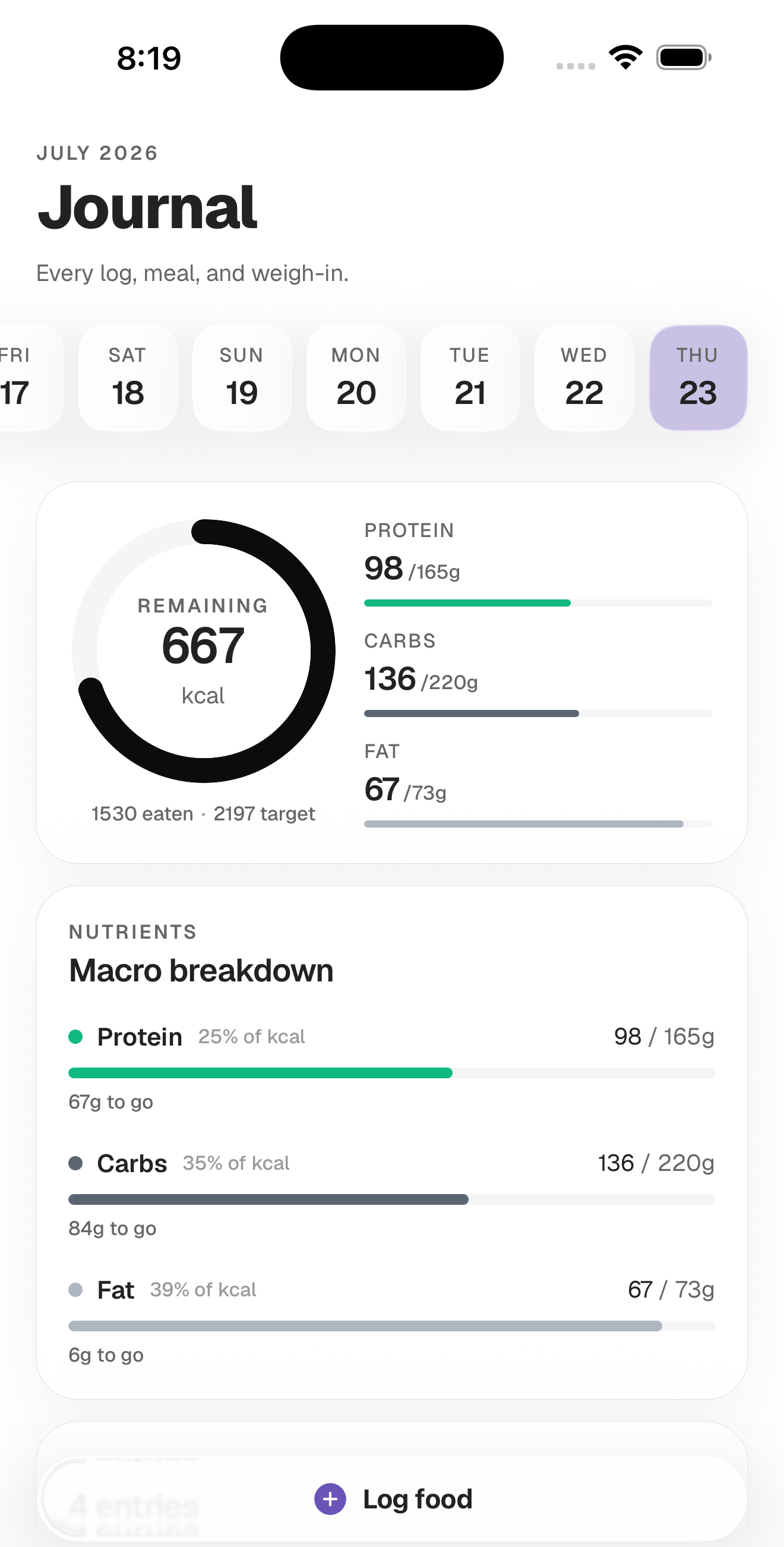
Corvex is built to this brief: one log sheet a tap from every screen with four ways in — describe the meal in plain words, scan a barcode, pull from recents, or enter macros by hand. Protein, carbs and fat as a share of the day with grams remaining, fibre tracked alongside. Weigh-ins as a trend line with start, current and target permanently in view. No ads on any tier.
The one non-essential is deliberate: progress stickers, a one-tap card for a streak or weight change shaped for Stories. It is the only feature that is not strictly logging, and it points out of the app rather than into a feed.
What it gives up is worth being blunt about. The food database is smaller than MyFitnessPal's or Lose It's, so unusual packaged and restaurant foods are harder to find. There are no micronutrients, no recipes, no meal plans, no community, and no Android version. If any of those is a requirement, a minimalist tracker is the wrong category and a bigger app is the honest answer.
FAQ
What makes a calorie tracker minimalist?
Not the colour scheme. A short path from opening the app to a logged meal, a day view that reads at a glance, no ads, no screens unrelated to food or weight, and a free tier that keeps repeat logging free. If repeating yesterday costs money, the app is not minimal — it is just quiet-looking.
Is a minimalist tracker accurate enough?
Accuracy in this category is limited by portion estimation and database entries, not by how many features the app has. A simpler app logged consistently beats a detailed one logged three days a week. What a minimal app should not drop is the weight trend, which is the only way to check whether your calorie estimates are systematically off.
Should a minimalist tracker include macros?
Protein is worth keeping — a target is meaningless without grams remaining. Carbs and fat are useful context and cost almost no interface. Beyond that, cutting is usually the right call.
Is Corvex free?
There is a genuinely usable free tier for daily logging, with no ads on any tier. Premium adds longer history, advanced charts and the full sticker library. Recents and repeat logging are not paywalled.
What is the most minimal option of all?
A notes app or a paper notebook, and for some people that genuinely is the right answer. What you lose is the arithmetic, the trend line and any way to see a pattern across months. If you have tried it and it stuck, there is no reason to change.
Sources
- [1] Burke LE, Wang J, Sevick MA. “Self-monitoring in weight loss: a systematic review of the literature” (2011) — Journal of the American Dietetic Association 111:92–102 (PMID 21185970)
- [2] Zheng Y, Klem ML, et al. “Self-weighing in weight management: a systematic literature review” (2015) — Obesity 23:256–265 (PMID 25521523)
- [3] Cronometer: Calorie Counter — App Store listing (Gold unlocks photo and voice logging, fasting tracker, recipe importer, repeat items and an ad-free experience) — Apple App Store, US storefront (checked 12 August 2026)
- [4] Lose It! – Calorie Counter — App Store listing (GLP-1 and medication logging, blood pressure, glucose, cholesterol and sleep tracking alongside calorie counting) — Apple App Store, US storefront (checked 12 August 2026)
General nutrition information, not medical advice. Calorie and macro targets are estimates — talk to a doctor or a registered dietitian before changing your diet, especially if you are pregnant, managing a health condition, or have a history of disordered eating.
Get the app
Open Corvex on your iPhone
Track calories, weight, and macros in a daily log you will actually keep — then share progress stickers in one tap.